
Tesla Cybertruck Approved for PG&E V2X Program: California's First AC Vehicle-to-Grid Rollout

By EVHQ Editorial Team · April 22, 2026 · EV News / Tesla
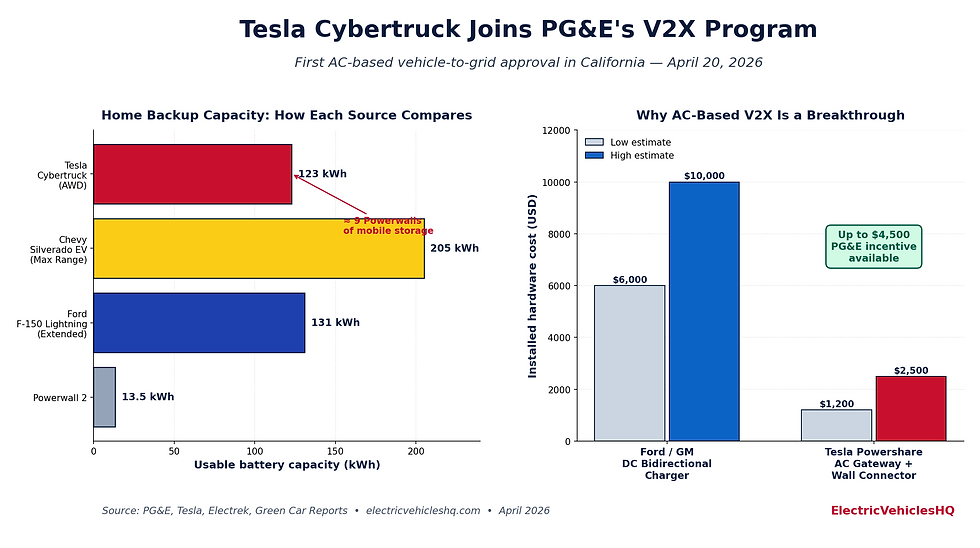
Infographic: Tesla Cybertruck joins PG&E's residential V2X program — AC-based hardware cost and battery capacity vs. Ford and GM DC systems. (ElectricVehiclesHQ • April 2026)
Tesla Cybertruck Approved for PG&E V2X Program: California's First AC Vehicle-to-Grid Rollout
Pacific Gas and Electric (PG&E) and Tesla have officially approved the Tesla Cybertruck for California's residential Vehicle-to-Everything (V2X) pilot program — a landmark moment for bidirectional charging in the United States. Announced on April 20, 2026, the approval makes the Cybertruck the first AC-based vehicle-to-grid (V2G) asset ever approved for home use in California, opening the door for Tesla's 123 kWh Powershare platform to become a meaningful grid resource across Northern and Central California.
For Cybertruck owners inside PG&E's service territory (roughly 16 million residents), the deal is unusually concrete. Enrolled homeowners can use their truck's battery to back up the house during an outage, export excess energy to the grid during high-demand events, and receive up to $4,500 in incentives toward the bidirectional hardware and interconnection costs. Tesla's system plugs into a standard Powershare Gateway and Universal Wall Connector — conventional AC residential gear — rather than the $6,000–$10,000 DC chargers that Ford and GM buyers have had to install.
That technical difference is the headline. California has approved DC-based V2G pilots since 2023 (Ford F-150 Lightning) and 2025 (GM's Ultium vehicles), but today marks the first time the state has blessed an AC-native, residential-grade bidirectional architecture. In this article we break down how the program works, what it pays, which Cybertruck configurations qualify, how it stacks up against Ford and GM's DC systems, what it means for EV buyers and investors, and where V2X goes next.
▶ Watch: "Power Your Home with the Cybertruck | Tesla Powershare Install + Details" — Good Faith Energy (YouTube). Good Faith Energy walks through a real Powershare install, including the Gateway, load panel, and what happens automatically during an outage. All video rights belong to the original creator.
Why This PG&E Cybertruck V2X Approval Matters
California is the most consequential proving ground for vehicle-to-grid technology in North America. The state's grid is stressed by heat waves, wildfire-driven public safety power shutoffs, and one of the highest residential electricity rates in the country. PG&E alone has roughly 5.5 million electric customer accounts — any meaningful shift in home energy storage ripples through the whole Western Interconnection.
Until today, residential V2G in California has been a hardware-heavy experiment. To enroll a Ford F-150 Lightning, a customer had to install a Sunrun Home Integration System; GM Ultium owners had to buy a GM Energy V2H Bundle. Both systems rely on DC bidirectional equipment that can cost between $6,000 and $10,000 installed, which has kept adoption modest despite PG&E's incentives.
Tesla's Powershare architecture flips that equation. Because the Cybertruck handles AC inversion on-board, the only external hardware needed is a Powershare Gateway and a Universal Wall Connector — both of which are already part of Tesla's standard home-charging lineup. Installed cost estimates for the full Powershare V2X package run closer to $1,200–$2,500, and PG&E's $4,500 incentive more than covers it.
1. What PG&E's V2X Program Actually Does
PG&E's residential V2X pilot is structured around the California Public Utilities Commission's Emergency Load Reduction Program (ELRP), which pays aggregated demand-response resources a minimum of $2 per kWh for at least 30 hours of dispatch per year. Customers enroll through Tesla or directly with PG&E, commit to a bidirectional configuration, and opt in to specific grid events.
Powershare Home Backup — automatically islands the house during an outage and powers it for up to three days at 11.5 kW.
Powershare Grid Support — exports stored energy to PG&E during peak-demand or wildfire-season grid events.
Up to $4,500 toward bidirectional equipment and interconnection costs.
Ongoing per-event compensation for participating in ELRP dispatches.
Bonus incentive for staying enrolled through the end of the pilot.
Driver retains full control — set a minimum state-of-charge, opt out of any event.
2. How the Cybertruck's 123 kWh Battery Changes the Math
The standard Cybertruck All-Wheel Drive carries a usable battery pack of roughly 123 kWh — about nine times a Tesla Powerwall 2 (13.5 kWh). In practical terms, a fully charged Cybertruck parked in the garage is equivalent to stacking most of a home battery wall on wheels, with the added benefit of being able to re-energize the pack from a DC fast charger in under 45 minutes when needed.
For context, U.S. households consumed an average of 29 kWh per day in 2024 according to the Energy Information Administration. A single Cybertruck could — in theory — run an average home for three-plus days on a full charge, which is why Tesla markets the three-day Powershare Home Backup figure conservatively. During a grid event, owners typically discharge only a slice of the pack (often capped at 20–30 kWh) so they preserve driving range for the next day.
3. AC vs. DC Bidirectional Charging, Explained
Every home runs on alternating current (AC). Every EV battery stores direct current (DC). The question for any V2X system is where the AC-to-DC inversion happens — inside the vehicle or inside an external wall box.
Ford's F-150 Lightning and GM's Ultium-platform vehicles use external DC bidirectional chargers (Sunrun's system for Ford, GM Energy's PowerBank and V2H Bundle for GM). That hardware is capable, but it adds cost and installation complexity: most installs require a new subpanel, load-shedding controls, and interconnection review.
Tesla's Powershare does the inversion onboard the Cybertruck itself, using the same power electronics that already handle AC charging in reverse. The external hardware is simpler, cheaper, and physically smaller — a Gateway the size of a Powerwall, plus the Wall Connector that any Tesla owner is already installing anyway.
Quick Comparison: V2X Hardware Across Automakers
Here is how the three approved California residential V2X systems compare across the metrics that matter most for buyers in 2026:
VEHICLE | HARDWARE TYPE | BATTERY (kWh) | EST. INSTALLED COST | PG&E INCENTIVE
——————————————————————————————————————————————————————————
Tesla Cybertruck AWD | AC (Powershare Gateway + Wall Connector) | 123 | $1,200–$2,500 | Up to $4,500
Ford F-150 Lightning ER | DC (Sunrun Home Integration System) | 131 | $6,000–$10,000 | Up to $4,500
Chevy Silverado EV Max Range | DC (GM Energy V2H Bundle) | 205 | $6,000–$10,000 | Up to $4,500
GMC Sierra EV / Blazer EV / Equinox EV | DC (GM Energy V2H Bundle) | 85–205 | $6,000–$10,000 | Up to $4,500
5-Year Value of Home Backup + Grid Events: A Realistic Example
Consider a PG&E customer in Santa Rosa who owns a 2026 Cybertruck AWD and enrolls in Powershare Grid Support. Assume they allow PG&E to dispatch an average of 20 kWh per event across 30 events per year at the ELRP floor of $2/kWh. That is $1,200/year in grid-event compensation before any bill credits.
Add the avoided cost of a dedicated Powerwall-class home battery ($11,500 installed for two Powerwall 3 units), the $4,500 hardware incentive, and the value of three days of outage backup in a service area that has averaged 16 PSPS events in recent fire seasons, and the five-year net value of Powershare grid participation plausibly exceeds $10,000 — before counting any fuel savings from driving the truck.
These numbers will vary with dispatch frequency, state-of-charge caps, and CAISO market prices, but they illustrate why Tesla has been so eager to get the Cybertruck approved: the Powershare program monetizes a battery the owner already bought.
Expert Perspectives and Market Context
Wood Mackenzie analysts have called 2025–2026 the inflection year for V2X commercialization, arguing that the technology has been bottlenecked by hardware cost and utility approvals rather than consumer demand. Moving to AC-native architectures, they note, lowers the hardware barrier enough to make whole-fleet rollouts credible.
Lawrence Berkeley National Laboratory research published through the California Energy Commission has estimated that if even 10% of California's 1.8 million registered EVs enrolled in V2X at 5 kW of export per event, the state could unlock roughly 900 MW of dispatchable capacity — more than a typical natural-gas peaker plant — at a fraction of the cost of building new generation.
For Tesla, the approval also opens a second product-pull revenue line. The more Cybertrucks qualify as grid assets, the stronger the case for Tesla Electric, Tesla's retail-electricity subsidiary, to bundle Powershare participation with generation and storage rates in California, Texas, and the other retail markets it is entering.
What This Means for EV Buyers and Investors
For buyers: If you live in PG&E territory and are on the fence about a Cybertruck, the V2X approval changes the calculus. The $4,500 hardware incentive plus grid-event income can offset a meaningful share of the truck's purchase price over five years, and Powershare Home Backup is arguably the cleanest whole-home outage solution on the market — no propane, no generator maintenance, no noise.
For investors: Tesla has been searching for a credible services revenue story beyond Full Self-Driving. Vehicle-grid integration — where Tesla is a software and aggregation layer sitting between customers, utilities, and wholesale markets — is precisely that story. PCG (PG&E) shareholders, meanwhile, benefit from a cheaper way to procure peak capacity and wildfire-resilient load relief at a time when the utility is under heavy regulatory pressure to control costs.
Bottom line: This is not a cosmetic program. It is the first time an AC-native, mass-market EV has been approved as a residential grid asset in the most consequential EV market in North America. Expect other utilities — Southern California Edison, SDG&E, ConEd, Eversource — to move fast on similar approvals before year-end.
Related Reading on ElectricVehiclesHQ
For a deeper look at how bidirectional charging works and which EVs currently support it, see our full explainer on vehicle-to-grid and vehicle-to-home technology for 2026.
If you're comparing the Cybertruck to other full-size electric trucks, check our Cybertruck vs. F-150 Lightning vs. Silverado EV buyers' guide on ElectricVehiclesHQ.
And for ongoing Tesla news and earnings coverage, visit our Tesla category page.
Frequently Asked Questions
How much does it cost to enroll a Cybertruck in PG&E's V2X program?
The required hardware — a Tesla Powershare Gateway plus a Universal Wall Connector — is estimated at $1,200 to $2,500 installed. PG&E provides up to $4,500 in incentives toward that hardware and interconnection costs, meaning most customers will net zero out-of-pocket on equipment.
Does my Cybertruck need any software or hardware changes to participate?
No hardware changes to the truck. Tesla delivers Powershare functionality through an over-the-air software update that is already available on current Cybertruck firmware. You do need the Powershare Gateway installed at your house to interconnect with the grid.
Will participating in V2X drain my Cybertruck battery or shorten its life?
You set a minimum state-of-charge for driving, and Tesla's battery management system throttles discharge to protect cycle life. Typical V2G events discharge 15–30 kWh — well under a full cycle. Real-world data from Ford F-150 Lightning and Nissan LEAF V2G pilots has shown negligible degradation impact over multi-year participation.
Can I still use my Cybertruck normally during a PG&E grid event?
Yes. Grid events are opt-in and scheduled in advance, and you can override any event from the Tesla app. You can also set a reserve state-of-charge so the truck never discharges below the level you need for the next day's driving.
How does AC-based V2G differ from the DC systems used by Ford and GM?
AC-based V2G does the power inversion onboard the vehicle, so the house-side hardware is a small AC gateway and wall connector. DC-based systems require an external bidirectional charger that runs $6,000–$10,000 installed. The Cybertruck is the first AC-native, residential V2G system approved in California.
Is this available outside California or PG&E territory?
Not yet. Today's approval covers PG&E's Northern and Central California service area. Tesla launched a Powershare Grid Support pilot with CenterPoint Energy and Oncor in Texas in February 2026, and additional utility partnerships are expected over the next 12–18 months.
Sources
• PG&E Investor Relations — 'PG&E and Tesla Turn Cybertruck into a Grid Asset' — April 20, 2026 — https://investor.pgecorp.com/news-events/press-releases/press-release-details/2026/PGE-and-Tesla-Turn-Cybertruck-into-a-Grid-Asset-Advancing-the-Future-of-Electric-Power-in-California/default.aspx
• Electrek — 'Tesla Cybertruck becomes first AC vehicle-to-grid asset in California through PG&E' — April 20, 2026 — https://electrek.co/2026/04/20/pge-tesla-cybertruck-first-ac-vehicle-to-grid-california/
• electrive.com — 'PG&E and Tesla integrate Cybertruck into V2G programme' — April 21, 2026 — https://www.electrive.com/2026/04/21/pge-and-tesla-integrate-cybertruck-into-v2g-programme/
• Benzinga — 'PG&E Approves Tesla Cybertruck For First-Of-Its-Kind Grid Program' — April 2026 — https://www.benzinga.com/markets/tech/26/04/51935608/pge-approves-tesla-cybertruck-for-first-of-its-kind-grid-program
• PG&E — 'Vehicle to Everything (V2X) Pilot Programs' — https://www.pge.com/en/clean-energy/electric-vehicles/getting-started-with-electric-vehicles/vehicle-to-everything-v2x-pilot-programs.html
• Green Car Reports — 'California GM EV owners could see $4,500 off home-backup hardware' — https://www.greencarreports.com/news/1145973_california-gm-ev-owners-could-see-4-500-off-home-backup-hardware
• California CPUC — 'Emergency Load Reduction Program (ELRP)' — https://www.cpuc.ca.gov/industries-and-topics/electrical-energy/electric-costs/demand-response-dr/emergency-load-reduction-program
• Tesla — 'Powershare' product page — https://www.tesla.com/powershare
Conclusion
The PG&E-Tesla Cybertruck V2X approval is one of the most consequential EV stories of 2026 so far. It converts the Cybertruck's oversized battery into a revenue-generating, resilience-generating grid asset at a cost point that is — for the first time — competitive with a stand-alone home battery system. And it validates AC-native bidirectional charging as a mass-market architecture, setting a template that other utilities and automakers will almost certainly copy.
The real test will come this wildfire season. If Powershare-enrolled Cybertrucks ride out PSPS events and deliver meaningful ELRP dispatches without owner complaints, the economic and political case for scaling residential V2X from a pilot to a default utility offering becomes very hard to ignore.
Stay ahead of the EV market — bookmark ElectricVehiclesHQ and check back daily for breaking EV news, buyer guides, and investor-grade analysis.
About the Author
EVHQ Editorial Team covers breaking EV news, product launches, charging policy, and the investor angle on the electric-vehicle transition for ElectricVehiclesHQ.com.
Last updated: April 22, 2026. This article will be updated as new information becomes available.
Video embedded above: "Power Your Home with the Cybertruck | Tesla Powershare Install + Details" by Good Faith Energy (YouTube). All rights belong to the original creator.
All brand names, trademarks, and logos mentioned in this article are the property of their respective owners. ElectricVehiclesHQ.com is not affiliated with Tesla, Inc., PG&E, Ford, or General Motors.
© 2026 ElectricVehiclesHQ.com — All original content rights reserved.


Comments